


How to Play the Hand and Foot Card Game
Looking for the perfect card game for your next family gathering? Meet Hand and Foot, a team-based game that’s far easier to learn than its multiple decks suggest. While playing with two separate hands per person—a “Hand” and a “Foot”—might sound complicated, the core gameplay is wonderfully straightforward. This guide will get you playing in minutes, with no prior experience needed. Check out daftar DORY189 to know more
The objective is to work with your partner to get rid of all your cards before other teams. You accomplish this by laying down groups of matching cards, aiming to create large collections called “books.” Once your team plays all the cards from both your Hand and Foot piles, you can “go out” to end the round and rack up significant bonus points.
This guide breaks everything down into manageable parts, from setup and gameplay to scoring, ensuring you can play your first round with confidence.
What You’ll Need to Get Started
Hand and Foot is played with several standard 52-card packs with their jokers included. As a rule of thumb, use one more deck than the number of players.
- For 2-3 players: Use 3 decks
- For 4 players: Use 5 decks
- For 6 players: Use 7 decks
Before shuffling, it’s crucial to know about the special cards. In Hand and Foot, there are two types of wild cards: all Jokers and all 2s. A wild card is a powerful tool that can substitute for any other card you need, helping you complete your sets much faster.
The only other things you’ll need are a pen and a pad of paper for keeping score. With your decks sorted and a way to track points, you’re ready to learn the objective.
The Goal of the Game: Score Points by Making “Books”
Winning in Hand and Foot is about accumulating the most points as a team over a full game, which consists of four distinct rounds. At the end of the four rounds, the team with the highest total score is declared the winner.
Unlike solo card games, Hand and Foot is all about partnership. You and your partner share a combined score and collectively build your sets of cards on the table. Communication and collaboration are key, as you will both play on the same sets to reach your goals faster. You win or lose as a team.
The main way you score is by creating melds, which are groups of three or more cards of the same rank (like three 8s or five Queens). The ultimate objective is to grow a meld into a book—a complete set of seven cards. Each book gives your team a large point bonus, and creating more books than the opposing team is the primary path to victory.
How to Set Up the Game: Dealing the “Hand” and the “Foot”
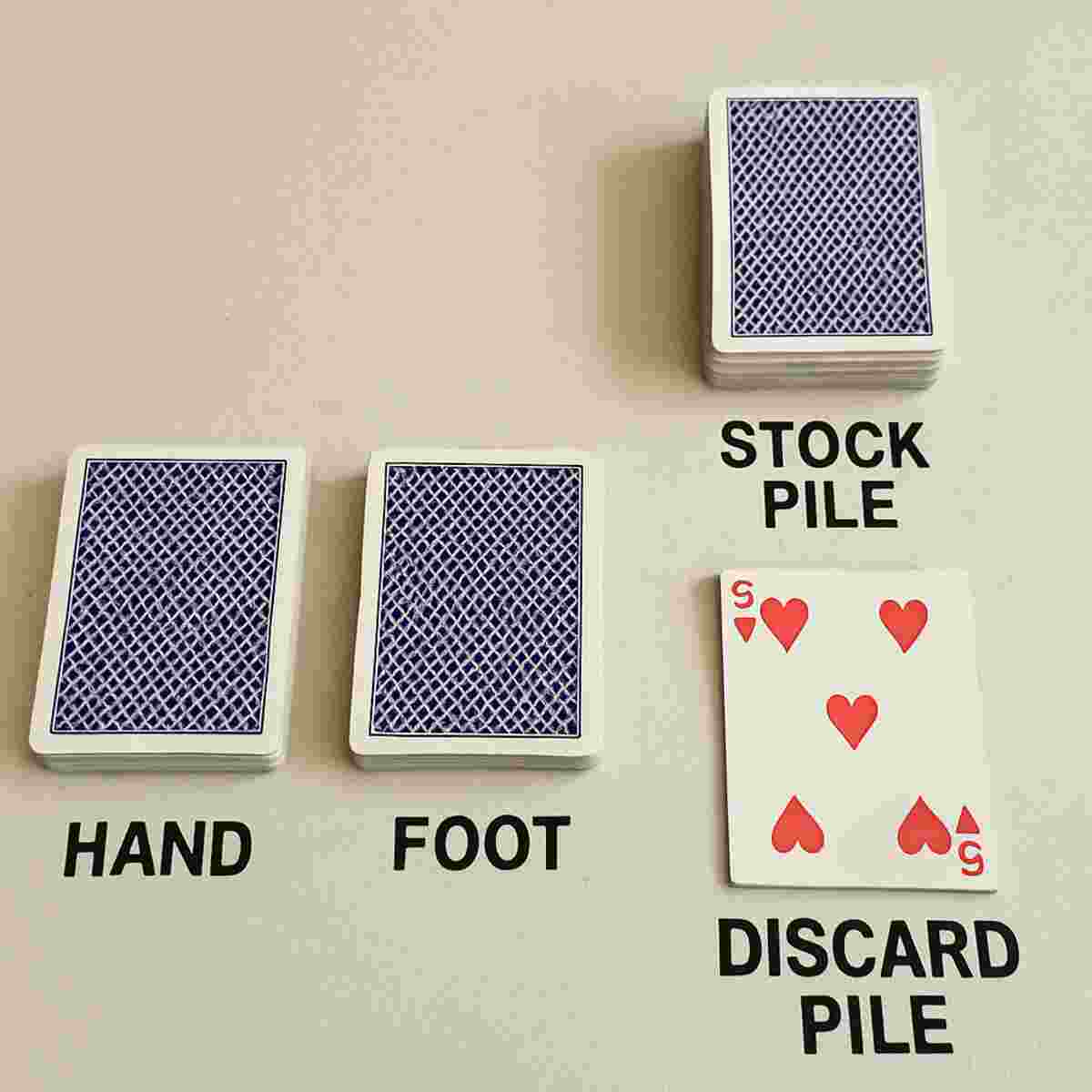
After thoroughly shuffling all the decks together, deal each player two separate piles of 11 cards, both face down. Make sure to keep these two stacks distinct from one another.
These two piles are your Hand and your Foot. Choose one to pick up—this is your Hand, and you’ll play with these cards first. The other pile is your Foot, which you must leave untouched and face down until you’ve played every card from your main Hand.
Once everyone has their Hand and Foot piles, place the remaining stack of cards in the center of the table to form the Stock pile. Take the top card from the Stock pile and place it face up next to it to create the starting Discard pile. Your playing area is now fully prepared.
How to Play Your Turn: The Simple 3-Step Rhythm
The game follows a simple and consistent three-part sequence for every player.
- Draw two cards from the Stock pile to begin your turn.
- Meld groups of matching cards from your hand (this is optional).
- Discard one card to end your turn.
Once you discard, your turn is officially over, and the player to your left begins their turn.
What Each Card Is Worth: A Guide to Points and Wild Cards
Each card has a point value that contributes to your team’s final score, so learning to spot the valuable ones is a huge advantage. As a reminder, Jokers and 2s are Wild Cards that can substitute for any other card rank.
Pay close attention to the Red 3s—they are penalty cards you cannot meld. If you’re caught with one at the end of the round, it will cost your team dearly.
- Jokers: 50 points (Wild)
- Aces & 2s: 20 points (2s are also Wild)
- 8s through Kings: 10 points
- 4s through 7s: 5 points
- Black 3s: 5 points
- Red 3s: -500 points (Penalty card if left in your hand)
Making “Books”: The Critical Difference Between Clean and Dirty
The main way you score is by playing groups of cards, called melds, from your hand onto the table. Any group of three or more cards of the same rank (e.g., three 8s) starts a meld. You and your partner build on the same melds, working together to grow them into a book—a completed set of exactly seven cards. Once a meld has seven cards, it is considered a finished book and cannot be added to.
Not all books are created equal. A clean book is a set of seven natural cards of the same rank, containing no wild cards. Because they are harder to complete, they are worth a 500-point bonus.
If you use one or more wild cards (Jokers or 2s) to complete your set of seven, you’ve made a dirty book. A group of five Kings plus two wild cards, for instance, is a dirty book. They are easier to make, but the bonus is smaller at 300 points. This 200-point difference often decides a game, making every decision about when to use a wild card a critical one.
The Game-Changing Move: Picking Up the Discard Pile
Instead of drawing two cards from the stock pile, you have a more powerful option: taking the entire discard pile. To do this, you must hold two cards in your hand that are the same rank as the top card of the pile. For example, if the top card is a Jack, you need two natural Jacks in your hand to claim it. You cannot use a wild card for this.
Once you prove you can take the top card, you must pick up the entire pile and add it to your hand. You are then required to immediately play the top card from the pile along with your matching pair, either starting a new meld or adding to an existing one.
This move is a cornerstone of strategy because it can turn a weak hand into a powerhouse. While taking a pile full of unknown cards can feel risky, having enough cards to complete multiple books can quickly shift the game in your favor.
How to Unlock Your Backup: The Rules for Getting Into Your “Foot”
Your “Foot” pile acts as a fresh set of reinforcements. You gain access to this backup hand the instant you have played the very last card from your main “Hand.” As soon as your hand is empty, you are officially allowed to pick up your Foot.
This happens immediately during your turn. After you play the card that empties your Hand, pick up your Foot pile. Your turn is still active, and you can immediately play any valid melds from those new cards. Once you have finished playing all the cards you can (or want to) from your new Foot, end your turn as you normally would: by discarding one card.
How to End a Round: The 3 Conditions for “Going Out”
Finishing a round, or going out, is how your team locks in its score. To end the round, one player must successfully meet three specific conditions on their turn.
- Book Requirement: Your team has melded the required number of clean and dirty books. A common requirement is at least one clean book and one dirty book.
- Partner’s Permission: You must ask your partner, “May I go out?” If they say yes, you can proceed. If they say no—perhaps because they have too many high-point cards left—you must continue playing.
- Final Discard: You must be able to play or meld all cards in your hand except for one, which you use as your final discard. You cannot go out if playing all your cards leaves you with nothing to discard.
Once a player successfully goes out, the round ends immediately for all players.
Tallying the Score: A Simple 3-Step Process
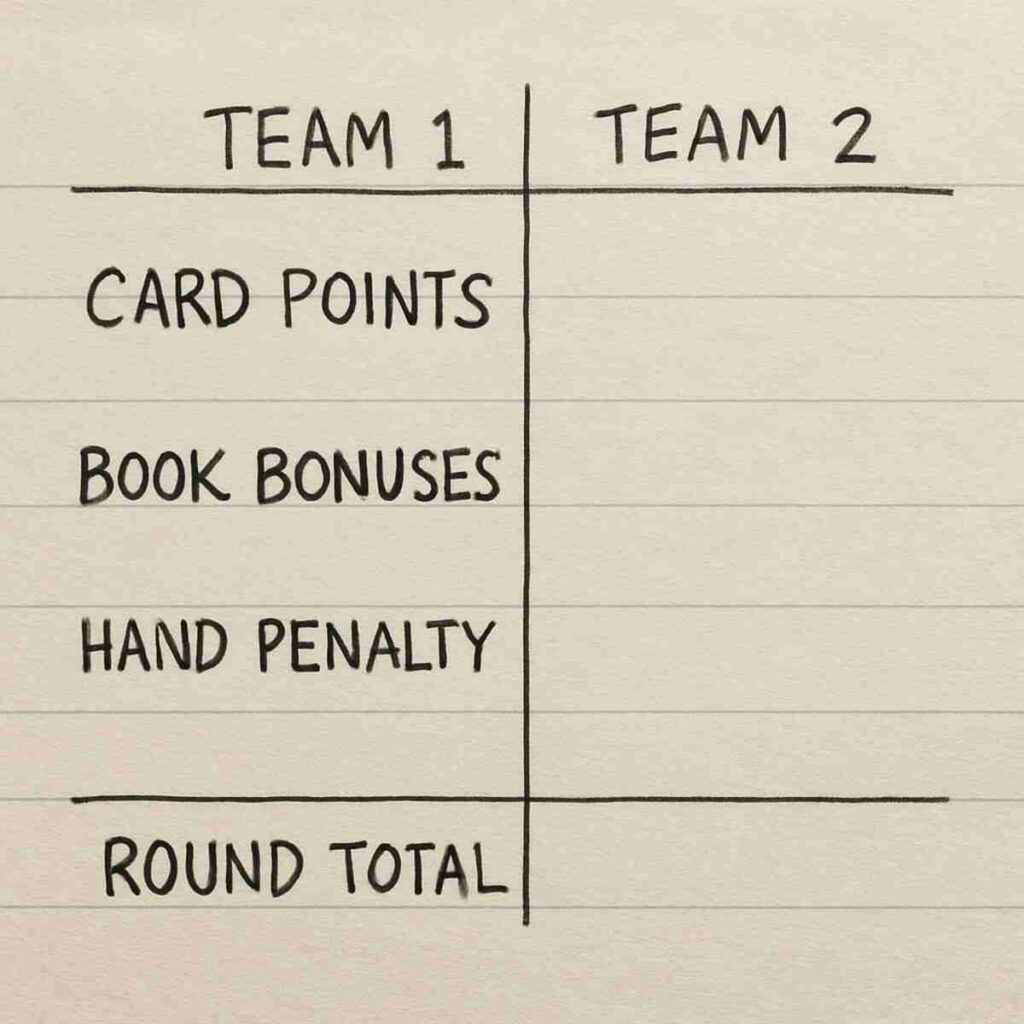
Once the round is over, it’s time to see which team came out ahead. The scoring process can be broken down into adding melded points, adding book bonuses, and subtracting penalties.
- Count Card Points: Add up the value of every single card your team melded. Use the standard values (Jokers 50, Aces/2s 20, 8-K 10, 4-7 & Black 3s 5).
- Add Bonuses: Give your team 500 points for each clean book and 300 for each dirty book. The team that went out receives an extra 100-point bonus.
- Subtract Penalties: Both partners on a team must count the point values of all cards remaining in their hands (and Foot). Subtract this total from your score. Any Red 3s caught in a player’s hand cost that team 500 points each.
Your team’s final score for the round is your card points plus bonuses, minus penalties. Record the total, and you’re ready for the next round.
Your Hand and Foot “Cheat Sheet” for Game Night
To make your first game a breeze, here is a quick-reference guide you can screenshot or jot down.
Hand and Foot: Game Night Cheat Sheet
- Setup: Use one more deck than the number of players. Deal each person two face-down piles of 11 cards: their Hand (to play first) and their Foot (a backup hand).
- Your Turn: Always follow this order: 1) Draw two cards, 2) Meld cards if you can, and 3) Discard one card to end your turn.
- Key Goals: Your main objective is to make books (seven cards of the same rank).
- Clean Book: 7 natural cards = 500 points
- Dirty Book: Contains wild cards (2s or Jokers) = 300 points
- Going Out: To end the round, you must: get your partner’s permission, have the required books, and play or discard the final card from your hand.
- Scoring: 1) Add points from all melded cards, 2) Add bonuses for books and for going out (+100), then 3) Subtract the point value of all cards left in your hands.
The best way to learn is to deal the cards, start drawing and discarding, and let the rhythm of the game guide you. Go start a new tradition.
